MATEX
Quick Contact
X

    Navigation
    Close menu
    Theme Color
    Light Dark

    Concrete Repair

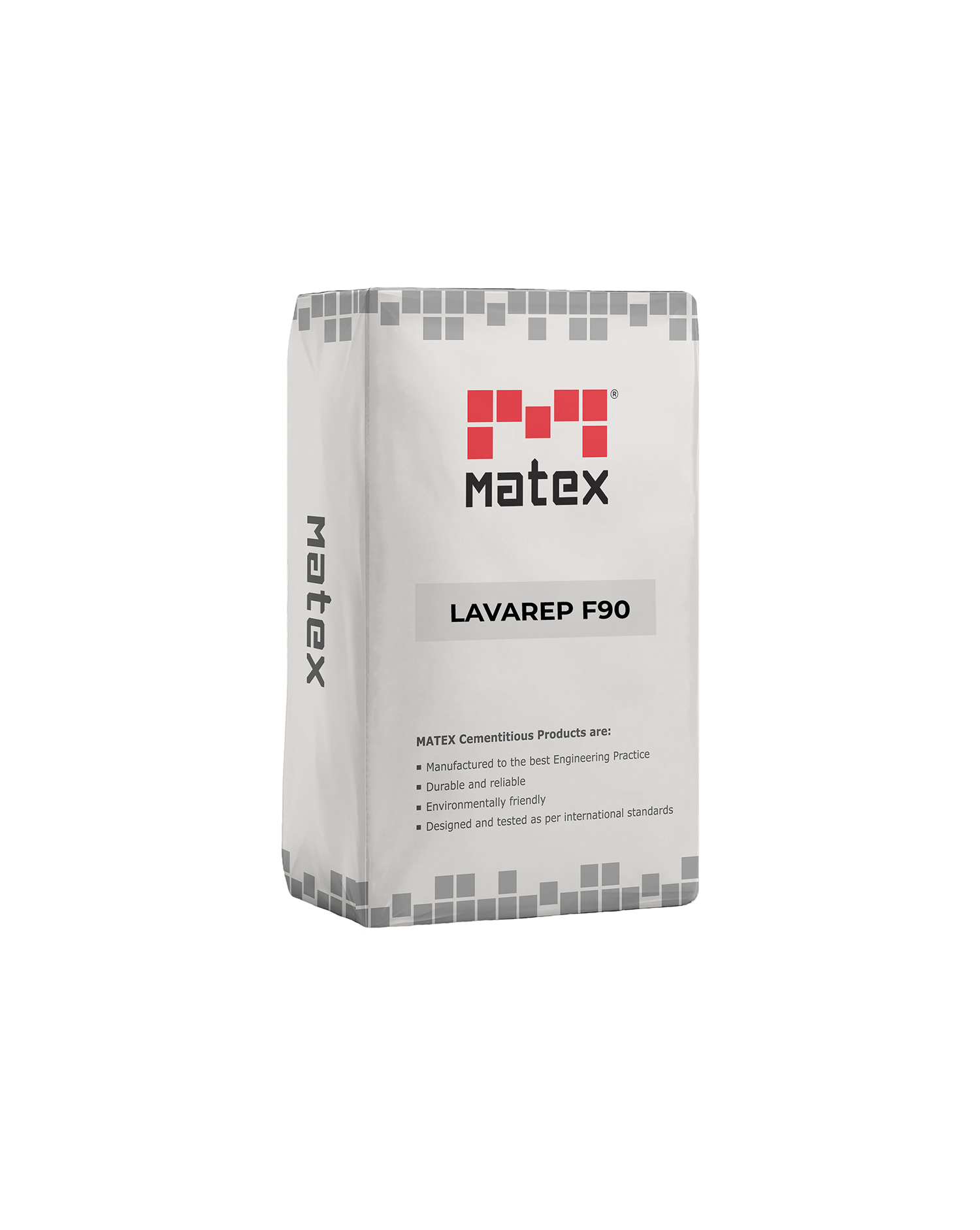
    Lavarep F90 high compressive strength shrinkage free cementitious repairing mortar by MATEX

    Lavarep F90

    High Compressive Strength Shrinkage Free Repairing Mortar

    LAVAREP F90 is a fiber-reinforced, polymer-modified, shrinkage-compensated repair mortar engineered for structural concrete rehabilitation in challenging conditions. Suitable for buildings, tunnels, water-retaining structures, bridges, floors, beams, and more, it provides excellent bond strength and monolithic repair performance. Its shrinkage-compensated formulation helps reduce cracking, while its high compressive strength and impact resistance offer reliable structural integrity. LAVAREP F90 exhibits outstanding resistance to acids, atmospheric gases, and chloride ingress, extending service life even in aggressive environments. It is re-coatable and fully compatible with cement-based systems, ensuring seamless integration with existing substrates.

    Technical data:
    • Appearance : Cement grey powder
    • Application Temperature : 5°C to 35°C
    • Thickness per coat : 10-50 mm (vertical) , 10-20 mm (overhead) , 10-100 mm (horizontal)
    • Coverage : 2.2 kg per square meter @ 1 mm thickness
    • Yield : 12.80 liters per 25 kg bag
    • Packaging : 25 kg bag

    How to Apply Lavarep F90

    Lavarep F90 is mixed with clean water and applied by trowel, spatula or mortar spray machine to a prepared, saturated surface dry (SSD) substrate.

    1. Prepare the concrete. Remove all grease, contaminants, oil and loose material using mechanical tools. To avoid feather edging, neatly cut the repair boundary with a concrete saw to a depth of 10 mm, and fully expose all corroded steel including the rear of the bar.
    2. Treat reinforcement. Clean reinforcing steel mechanically, paying attention to the rear of the bar to remove all corrosion products. Immediately coat the cleaned steel with one coat of Lavazinc EP or Lavafer.
    3. Saturate or prime. Soak the substrate with water and allow excess to evaporate or use a sponge to reach a saturated surface dry (SSD) condition. If application must be done in a short period, apply a Megabond SBR slurry bonding coat.
    4. Mix. Pour 3.0-3.2 liters of clean water into a container and slowly add the 25 kg bag. Mix with a spiral paddle on a slow-speed heavy-duty drill for 3-5 minutes until homogeneous and lump free; always add powder to water and do not add extra water.
    5. Apply. Apply manually with a trowel or spatula to the SSD surface: 10 mm up to 50 mm on vertical surfaces and up to 100 mm per layer on horizontal surfaces. For a second vertical layer, apply the first with proper pushing and roughen it to improve bond.
    6. Spray large areas (optional). For large repair areas the mortar can be sprayed with a mortar spray machine. Check the gauging water and apply a sample area to confirm consistency and bond before full application.
    7. Cure. Protect the repair from drying winds, sun or excessive heat. Cover with wet hessian cloth and polyethylene sheet for two days, or apply a recommended MATEX curing agent.
    8. Clean tools. Clean tools with water before the product hardens. Hardened material can only be removed mechanically.

    Summary of the method in the Lavarep F90 Technical Data Sheet. Always follow the full TDS on site.

    Standards & Test Methods

    StandardTitleReferenced for
    EN 1504-3Products and systems for the protection and repair of concrete structures — Structural and non-structural repairClass R4 structural repair mortar (listed under Standards in the TDS); TDS gives no explicit compliance statement
    ASTM C109Standard Test Method for Compressive Strength of Hydraulic Cement Mortars (Using 2-in. or [50 mm] Cube Specimens)Compressive strength
    ASTM C580Standard Test Method for Flexural Strength and Modulus of Elasticity of Chemical-Resistant Mortars, Grouts, Monolithic Surfacings, and Polymer ConcretesFlexural strength
    BS 6319-7Testing of resin and polymer/cement compositions for use in construction — Method for measurement of tensile strengthTensile strength
    ASTM C157Standard Test Method for Length Change of Hardened Hydraulic-Cement Mortar and ConcreteListed in the TDS
    ASTM C579Standard Test Methods for Compressive Strength of Chemical-Resistant Mortars, Grouts, Monolithic Surfacings, and Polymer ConcretesListed in the TDS

    Standards and test methods as referenced in the Lavarep F90 Technical Data Sheet. Values in the TDS are typical laboratory results under standard conditions.

    Frequently Asked Questions

    What is the compressive strength of Lavarep F90?

    Lavarep F90 achieves >70 N/mm² at 7 days and >85 N/mm² at 28 days, tested to ASTM C109.

    How thick can Lavarep F90 be applied per coat?

    Thickness per coat is 10-50 mm vertical, 10-20 mm overhead and 10-100 mm horizontal.

    How much water is needed to mix Lavarep F90?

    Use 3.0-3.2 liters of clean water per 25 kg bag. Mixed with 3.2 liters of water, one bag yields 12.8 liters.

    What is the coverage of Lavarep F90?

    Lavarep F90 covers approximately 2.2 kg per square meter at 1 mm thickness. Coverage is approximate and subject to site conditions.

    What is the chloride permeability of Lavarep F90?

    The TDS gives a rapid chloride permeability of <500 coulombs and water absorption of <2.0%.

    Quick Contact