MATEX
Quick Contact
X

    Navigation
    Close menu
    Theme Color
    Light Dark

    Concrete Repair

    Lavarep F40 fiber reinforced shrinkage compensated cementitious repairing mortar by MATEX

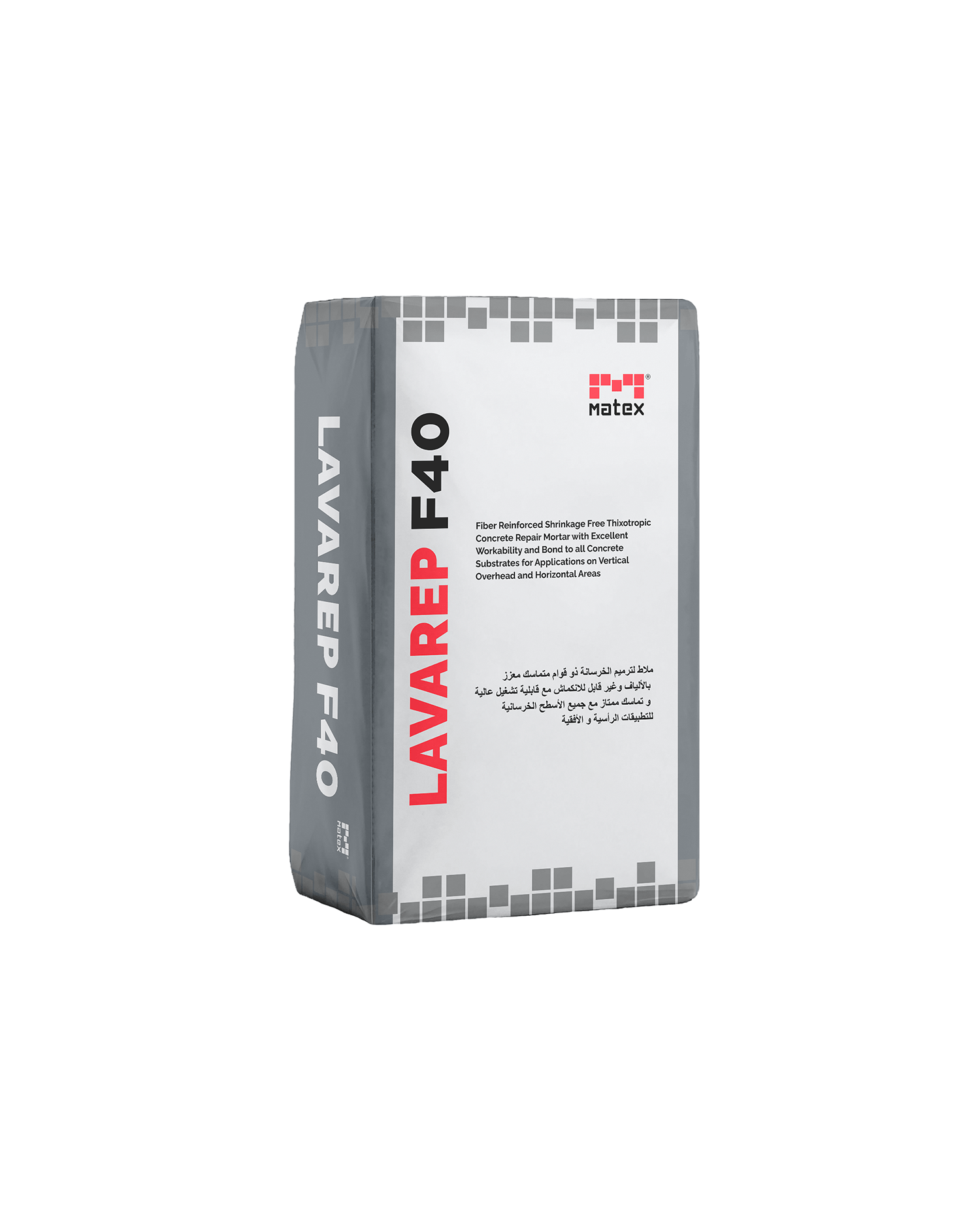
    Lavarep F40

    Fiber Reinforced Shrinkage Compensated Repairing Mortar

    LAVAREP F40 is a premixed, fiber-reinforced, polymer-modified repair mortar designed for structural concrete restoration. Made with hydraulic binders, silica sand, graded aggregates, additives, and reinforcing fibers, it provides excellent compressive strength and adhesion. This single-component mortar requires only water for use and is suitable for vertical, overhead, or horizontal repairs without formwork. Its shrinkage-compensated formulation minimizes cracking risks, and its thixotropic consistency ensures outstanding workability. LAVAREP F40 is ideal for patching, profiling, and restoring concrete in infrastructure and building repairs, delivering high mechanical performance and long-term durability under harsh environmental conditions.

    Technical data:
    • Appearance : cement grey powder
    • Application Temperature : 5°C to 35°C
    • Thickness per coat : 5-35 mm (vertical) , 5-20 mm (overhead) , 5-100 mm (horizontal)
    • Coverage : 2.2 kg per square meter @ 1 mm thickness
    • Yield : 13.2 liters per 25 kg bag
    • Packaging : 25 kg bag

    How to Apply Lavarep F40

    Lavarep F40 is mixed with clean water and applied by trowel, spatula or mortar spray machine to a prepared, saturated surface dry (SSD) substrate.

    1. Cut and break out. Mark the boundary of the damaged concrete and cut neatly with a saw cutting machine or disc grinder to a depth of 10 mm; feather edges are not permitted. Chip the concrete within the boundary down to a sound base and fully expose corroded steel including the rear of the bar.
    2. Clean and treat reinforcement. Clean the substrate of grease, contaminants, oil and loose material with a steel brush; use sand blasting on the reinforcing steel for deep rusting. Immediately coat the cleaned steel with one coat of Lavazinc EP or Lavafer, and add bars where the section is reduced by oxidation.
    3. Saturate and prime. Soak the substrate with water and let excess drain or evaporate to a saturated surface dry (SSD) condition. For superior bond, apply a Megabond SBR slurry bonding coat before the repair mortar.
    4. Mix. Pour 3.75-4.25 liters of clean water into a container and slowly add the 25 kg bag. Mix with a spiral paddle on a slow-speed heavy-duty drill until homogeneous and lump free; always add powder to water and do not add extra water.
    5. Apply. Force the mortar lightly into the prewetted substrate with a trowel or spatula. Minimum thickness is about 5 mm; maximum about 35 mm vertical and 20 mm overhead. For a second coat, cross-hatch and roughen the previous layer and let it take its initial set.
    6. Spray large areas (optional). For large repair areas the mortar can be sprayed with a mortar spray machine. Check the gauging water and apply a sample area to confirm consistency and bond before full application.
    7. Cure. Protect the repair from drying winds, sun or excessive heat. Cover with wet hessian cloth and polyethylene sheet for two days, or apply a recommended MATEX curing agent.
    8. Clean tools. Clean tools with water before the product hardens. Hardened material can only be removed mechanically.

    Summary of the method in the Lavarep F40 Technical Data Sheet. Always follow the full TDS on site.

    Standards & Test Methods

    StandardTitleReferenced for
    ASTM C109Standard Test Method for Compressive Strength of Hydraulic Cement Mortars (Using 2-in. or [50 mm] Cube Specimens)Compressive strength
    ASTM C580Standard Test Method for Flexural Strength and Modulus of Elasticity of Chemical-Resistant Mortars, Grouts, Monolithic Surfacings, and Polymer ConcretesFlexural strength
    BS 1881-207Testing concrete — Recommendations for the assessment of concrete strength by near-to-surface testsAdhesion to concrete after 28 days
    BS 1881-122Testing concrete — Method for determination of water absorptionWater absorption
    BS 6319Testing of resin and polymer/cement compositions for use in constructionListed in the TDS
    DIN 1048Testing methods for concrete (Prüfverfahren für Beton)Listed in the TDS
    ASTM C157Standard Test Method for Length Change of Hardened Hydraulic-Cement Mortar and ConcreteListed in the TDS
    ASTM C579Standard Test Methods for Compressive Strength of Chemical-Resistant Mortars, Grouts, Monolithic Surfacings, and Polymer ConcretesListed in the TDS

    Standards and test methods as referenced in the Lavarep F40 Technical Data Sheet. Values in the TDS are typical laboratory results under standard conditions.

    Frequently Asked Questions

    What is the compressive strength of Lavarep F40?

    Lavarep F40 achieves >28 N/mm² at 7 days and >40 N/mm² at 28 days, tested to ASTM C109.

    What thickness per coat can Lavarep F40 be applied at?

    The TDS technical table gives 5-35 mm vertical, 5-20 mm overhead and 5-100 mm horizontal per coat.

    How much water do I add to a bag of Lavarep F40?

    Add 3.75-4.25 liters of clean water per 25 kg bag. With 4.0 liters of water, one bag yields 13.2 liters of mortar.

    What is the coverage of Lavarep F40?

    Lavarep F40 covers approximately 2.2 kg per square meter at 1.0 mm thickness. Coverage is approximate and subject to site conditions.

    What is the shelf life of Lavarep F40?

    Lavarep F40 can be used within 12 months of production if stored unopened in original packing in dry conditions away from direct sunlight and high humidity. It is supplied in 25 kg paper bags.

    Quick Contact