
MATEX
Quick Contact
X

    Navigation
    Close menu
    Theme Color
    Light Dark

    Concrete Repair

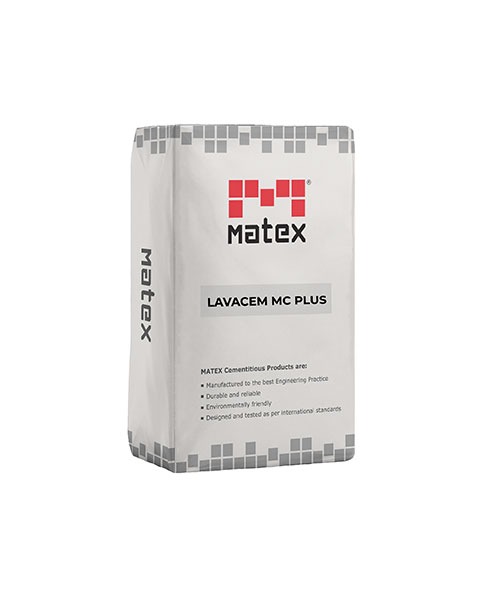
    Lavacem MC Plus high strength flowable non-shrink cementitious micro concrete by MATEX

    Lavacem Mc Plus

    High Strength Flowable Non-Shrink Micro Concrete

    LAVACEM MC PLUS is a high-performance, cement-based micro concrete designed for structural void filling and concrete repairs. This single-component, flowable, non-shrink formulation offers high early and final compressive strength with a low water-to-powder ratio. It ensures full consolidation without segregation or honeycombing, even in vertical and hard-to-reach areas. LAVACEM MC PLUS bonds exceptionally well to concrete and offers high impact resistance, low permeability, and resistance to chlorides, freeze-thaw cycles, and aggressive chemicals. Chloride-free and low in alkalinity, it’s ideal for structural rehabilitation projects demanding durability and dimensional stability.

    Technical data:
    • Appearance : Grey powder
    • Application Temperature : 5°C to 40°C
    • Setting time : initial: 2 hours , Final: 4 hours
    • Coverage : 2.3 kg/square meter @ 1 mm thickness
    • Yield : 12.0 liter per 25 kg bag
    • Packaging : 25 kg bag

    How to Apply Lavacem Mc Plus

    Lavacem MC Plus is mixed with water and poured continuously into sealed formwork over a saturated, prepared concrete substrate.

    1. Prepare the substrate. Remove grease, contaminants, oil and loose material with mechanical tools. Saw cut the repair edges to a depth of 50 mm to avoid feather edging; do not use Lavacem MC Plus on smooth concrete, roughen it for mechanical bond.
    2. Clean and prime the rebar. Mechanically clean the reinforcing steel, paying attention to the rear of the bar. Immediately coat it with one coat of Lavazinc EP or Lavafer.
    3. Pre-wet the concrete. Soak the substrate with water and let the excess drain to a saturated surface dry (SSD) condition. Applying over dry concrete without saturation or a bonding agent may cause bond failure.
    4. Erect and seal formwork. Erect clean formwork extending 5 cm beyond the repair cutting edge and seal it to prevent bleeding at the edges. Form a ‘bird mouth’ pouring entrance on the upper side to deliver material behind the formwork.
    5. Mix. Pour 2.6 – 2.9 liters of clean water into a container and slowly add the whole 25 kg bag. Mix with a spiral paddle on a slow-speed heavy-duty mixer for a few minutes until lump-free; always add powder to water and do not add more water afterward.
    6. Pour continuously. Pour immediately and continuously until the whole repair area is filled, with enough mixing capacity and labor to avoid interruptions. Fill depths from 50 mm minimum up to 500 mm maximum, and add reinforcement as needed for mass pours.
    7. Strip and cure. Remove the formwork after setting. Prevent rapid evaporation by curing with clean water for two days or applying a recommended MATEX curing agent.
    8. Clean tools. Clean tools with water before the product hardens. Hardened material can only be removed mechanically.

    Summary of the method in the Lavacem Mc Plus Technical Data Sheet. Always follow the full TDS on site.

    Standards & Test Methods

    StandardTitleReferenced for
    EN 1504-3Products and systems for the protection and repair of concrete structures — Structural and non-structural repairClass R4 (listed as ‘EN 1504-3, class R4’ under Standards in the TDS); TDS gives no explicit compliance statement
    ASTM C109Standard Test Method for Compressive Strength of Hydraulic Cement Mortars (Using 2-in. or [50 mm] Cube Specimens)Compressive strength: >70 N/mm2 at 7 days, >85 N/mm2 at 28 days
    ASTM C348Standard Test Method for Flexural Strength of Hydraulic-Cement MortarsFlexural strength: >9.0 N/mm2 at 28 days
    BS 1881-207Testing concrete — Recommendations for the assessment of concrete strength by near-to-surface testsAdhesion bond to concrete: >1.6 N/mm2
    BS 1881-122Testing concrete — Method for determination of water absorptionWater absorption: <2.0%
    ASTM C579Standard Test Methods for Compressive Strength of Chemical-Resistant Mortars, Grouts, Monolithic Surfacings, and Polymer ConcretesListed in the TDS

    Standards and test methods as referenced in the Lavacem Mc Plus Technical Data Sheet. Values in the TDS are typical laboratory results under standard conditions.

    Frequently Asked Questions

    What depth can Lavacem MC Plus micro concrete be poured at?

    Lavacem MC Plus fills gaps from at least 50 mm minimum depth up to a maximum of 500 mm. Greater depths may be applied depending on the design of the structure being repaired.

    How much water is needed per bag of Lavacem MC Plus?

    Use 2.6 – 2.9 liters of clean water per 25 kg bag. The TDS states a yield of 12.0 liters of mixture per 25 kg bag with 2.6 liters of water.

    What is the compressive strength of Lavacem MC Plus?

    Compressive strength is >70 N/mm2 at 7 days and >85 N/mm2 at 28 days (ASTM C109).

    What is the setting time and workability of Lavacem MC Plus?

    Initial setting time is 2 hours and final setting time 4 hours, with workability of 30-40 minutes at 25°C. Application temperature is 5°C to +40°C.

    How should Lavacem MC Plus be cured?

    After setting, remove the formwork and prevent rapid evaporation by curing with clean water for two days or applying a recommended MATEX curing agent.

    Quick Contact