
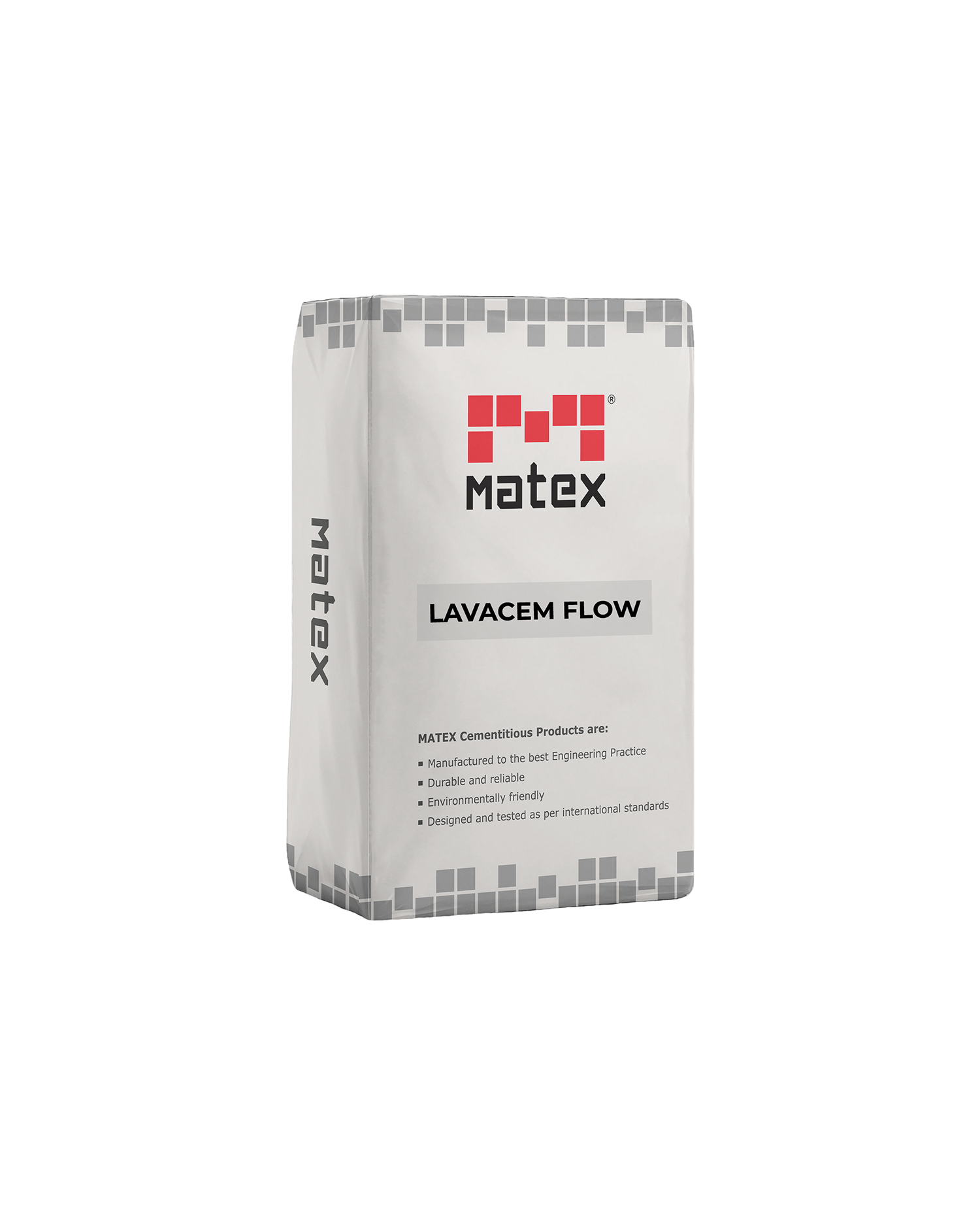
LAVACEM FLOW is a single-component, flowable, non-shrink repair mortar developed for precision concrete restoration. Comprising Portland cement, hydraulic binders, graded silica, fibers, and advanced additives, it offers excellent workability with low water content. Its self-compacting formula ensures full consolidation, minimizing segregation and honeycombing in restricted spaces. LAVACEM FLOW achieves high early and final compressive strength, forming a dense matrix that bonds strongly to concrete. Engineered for durability, it resists chemical attack, chloride ingress, freeze-thaw cycles, and environmental gases. This makes it ideal for structural rehabilitation and repair under demanding service conditions.
Lavacem Flow is mixed with water and poured continuously into sealed formwork over a saturated, prepared concrete substrate.
Summary of the method in the Lavacem Flow Technical Data Sheet. Always follow the full TDS on site.
| Standard | Title | Referenced for |
|---|---|---|
| EN 1504-3 | Products and systems for the protection and repair of concrete structures — Structural and non-structural repair | Class R4 (listed as ‘EN 1504-3, class R4’ under Standards in the TDS); TDS gives no explicit compliance statement |
| ASTM C109 | Standard Test Method for Compressive Strength of Hydraulic Cement Mortars (Using 2-in. or [50 mm] Cube Specimens) | Compressive strength: ≥38 N/mm2 at 7 days, ≥60 N/mm2 at 28 days |
| ASTM C580 | Standard Test Method for Flexural Strength and Modulus of Elasticity of Chemical-Resistant Mortars, Grouts, Monolithic Surfacings, and Polymer Concretes | Flexural strength: ≥7.0 N/mm2 at 28 days |
| ASTM C157 | Standard Test Method for Length Change of Hardened Hydraulic-Cement Mortar and Concrete | Shrinkage: NIL (TDS table cites ‘ASTM 157-93’) |
| BS 1881-207 | Testing concrete — Recommendations for the assessment of concrete strength by near-to-surface tests | Adhesion bond to concrete: >1.6 N/mm2 |
| BS 4550 | Methods of testing cement | Setting time: initial 2 hours, final 4 hours |
| BS 6319-7 | Testing of resin and polymer/cement compositions for use in construction — Method for measurement of tensile strength | Tensile strength: ≥4.0 N/mm2 at 28 days |
Standards and test methods as referenced in the Lavacem Flow Technical Data Sheet. Values in the TDS are typical laboratory results under standard conditions.
Lavacem Flow can be used for thicknesses from 20 mm up to 200 mm in defined spaces. For higher thickness, up to 30% of 5–8 mm graded aggregate can be added, which can increase the applied thickness by 80 mm.
Mix the whole 25 kg bag into 3.5 liters of clean water. This yields 13.5 liters of mortar per bag.
Coverage is approximately 2.1 kg per square meter per 1 mm thickness, subject to site conditions.
Initial setting time is 2 hours and final setting time 4 hours (BS 4550). Compressive strength is ≥38 N/mm2 at 7 days and ≥60 N/mm2 at 28 days (ASTM C109).
The application temperature range is 5°C to +40°C.