
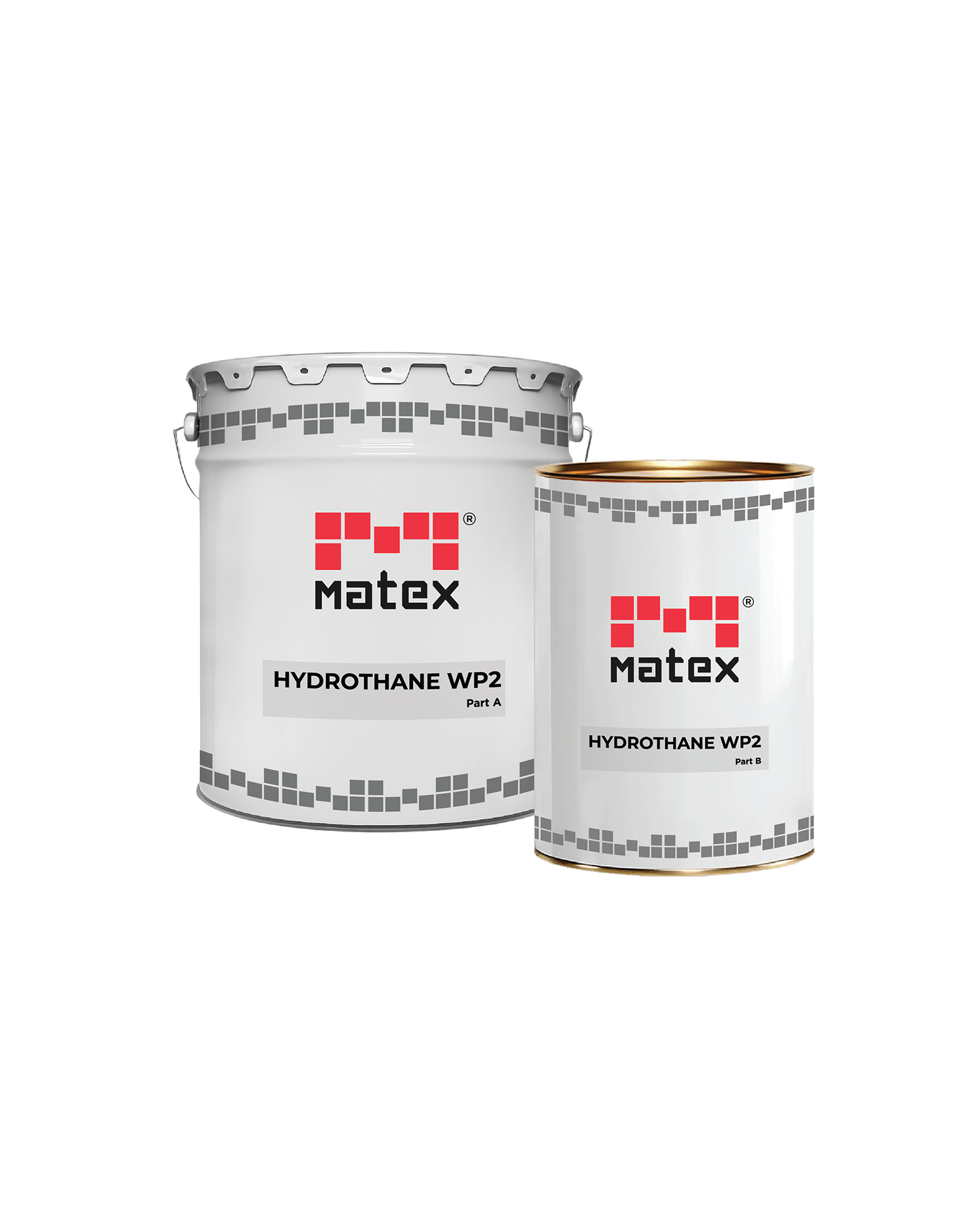
Hydrothane Wp2
Elastomeric Two-Part Polyurethane Waterproofing Membrane
HYDROTHANE WP2 is a solvent-free, two-component, liquid-applied elastomeric waterproofing membrane formulated from aromatic polyurethane resins for superior elasticity and durability. Once cured, HYDROTHANE WP2 forms a high-build, seamless, monolithic membrane with outstanding impermeability and mechanical strength. It is ideal for waterproofing areas requiring high flexibility and chemical resistance, such as foundations, industrial wet zones, and as an intermediate membrane in car park systems. The product is fast drying, tar-free, low odour, and offers excellent crack-bridging capabilities. It bonds strongly to both new and existing substrates, is resistant to detergents, brackish and salt water, and can be easily applied using standard manual tools.
Technical data:
- Color/Appearance : white or grey liquid coating (other colors upon request)
- Touch dry : 24 hours
- Full dry : 7 days
- Application Temperature : 5°C to 40°C
- Coverage : 1.2 liter per 1m² @ 1mm thickness
- Packaging : 4 & 15 lit kit
How to Apply Hydrothane Wp2
Hydrothane WP2 is a two component aromatic polyurethane membrane that is mixed on site and applied in two coats by squeegee, brush, roller or airless spray.
- Prepare the surface. The surface must be sound, clean, dry and free from loose and flaking material, efflorescence, laitance, curing compounds, dirt, oil, rust and grease, with projections and rough spots dressed off. Concrete should be cured for at least 28 days with moisture content below 5%; use grinding or grit/captive blasting on deeply contaminated or old surfaces.
- Treat cracks, corners and voids. Fill non-moving cracks with a pretreatment strip of Hydrothane WP2 at least 1.0 mm thick, extended 50 mm on both sides. Form coving fillets at parapets and columns with Lavarep F40 and apply a 1 mm reinforcing strip extending 100 mm on both sides; patch voids and honeycombs with concrete repair products and let them cure.
- Prime porous substrates and prepare metal. On porous substrates, apply a rich coat of Armoprime EP100 solvent free epoxy primer. Sandblast or mechanically prepare metal surfaces to bright steel and apply the product directly.
- Detail expansion joints. Seal expansion joints with Megaseal PU1. Once cured, apply a 200 mm wide strip of Hydrothane WP2 centered over the joint, embed a cut strip of fiber mesh while wet, cover it with another coat and allow the strip to cure.
- Mix. Mix component A (Base) with a low speed mixer for one minute, slowly add part B (Hardener) and mix with a suitable paddle for 3-4 minutes to a homogeneous, lump free mix. Avoid over mixing to limit air entrapment, and do not mix more than can be used within the 30 minute pot life (at 25°C).
- Apply two coats. Apply the first coat at 1.2 lit/m² @ 1 mm thickness. Apply the second coat at the same rate, preferably at right angles, once the first coat is completely dry; minimum recommended thickness in below ground structures, wet areas and roofs is 1.2 mm.
- Finish and protect. Do not leave the membrane exposed for long periods; use protection sheets. Where it will be fully exposed to sun, apply Armofloor UVR after curing; in car park systems, broadcasting quartz improves grip for subsequent polyurethane layers but reduces flexibility.
- Clean tools and water test. Clean tools with Armosolvent before the product hardens; hardened material can only be removed mechanically. Run the water test after full cure (minimum 7 days).
Summary of the method in the Hydrothane Wp2 Technical Data Sheet. Always follow the full TDS on site.
Standards & Test Methods
| Standard | Title | Referenced for |
| ASTM D412 | Standard Test Methods for Vulcanized Rubber and Thermoplastic Elastomers—Tension | Tensile strength, elongation, modulus of elasticity and recovery from 100% extension |
| ASTM D624 | Standard Test Method for Tear Strength of Conventional Vulcanized Rubber and Thermoplastic Elastomers | Tear resistance |
| ASTM D4541 | Standard Test Method for Pull-Off Strength of Coatings Using Portable Adhesion Testers | Adhesion to concrete (table cites ASTM 4541-02) |
| ASTM E96 | Standard Test Methods for Water Vapor Transmission of Materials | Water vapor transmission |
| ASTM C836 | Standard Specification for High Solids Content, Cold Liquid-Applied Elastomeric Waterproofing Membrane for Use with Separate Wearing Course | Listed in the TDS |
Standards and test methods as referenced in the Hydrothane Wp2 Technical Data Sheet. Values in the TDS are typical laboratory results under standard conditions.
Frequently Asked Questions
What is the coverage of Hydrothane WP2?
Hydrothane WP2 covers 1.2 liter per m² at 1.0 mm thickness. This is approximate and subject to actual site conditions.
What thickness of Hydrothane WP2 is recommended?
Apply two coats. In below ground structures, wet areas and roofs, the minimum recommended thickness is 1.2 mm.
What is the pot life and drying time of Hydrothane WP2?
Pot life is 30 minutes at 25°C. It is touch dry in 24 hours and fully dry in 7 days, and the water test should be run after a minimum of 7 days.
What primer is used with Hydrothane WP2?
On porous substrates, apply a rich coat of Armoprime EP100 solvent free epoxy primer to improve mechanical adhesion.
How is Hydrothane WP2 packed and stored?
It is supplied in 4 and 15 liter sets in metal dual packs. Stored unopened in dry, temperature-controlled conditions at +5°C to +25°C away from direct sunlight, it can be used within 12 months of production.