
MATEX
Quick Contact
X

    Navigation
    Close menu
    Theme Color
    Light Dark

    Waterproofing

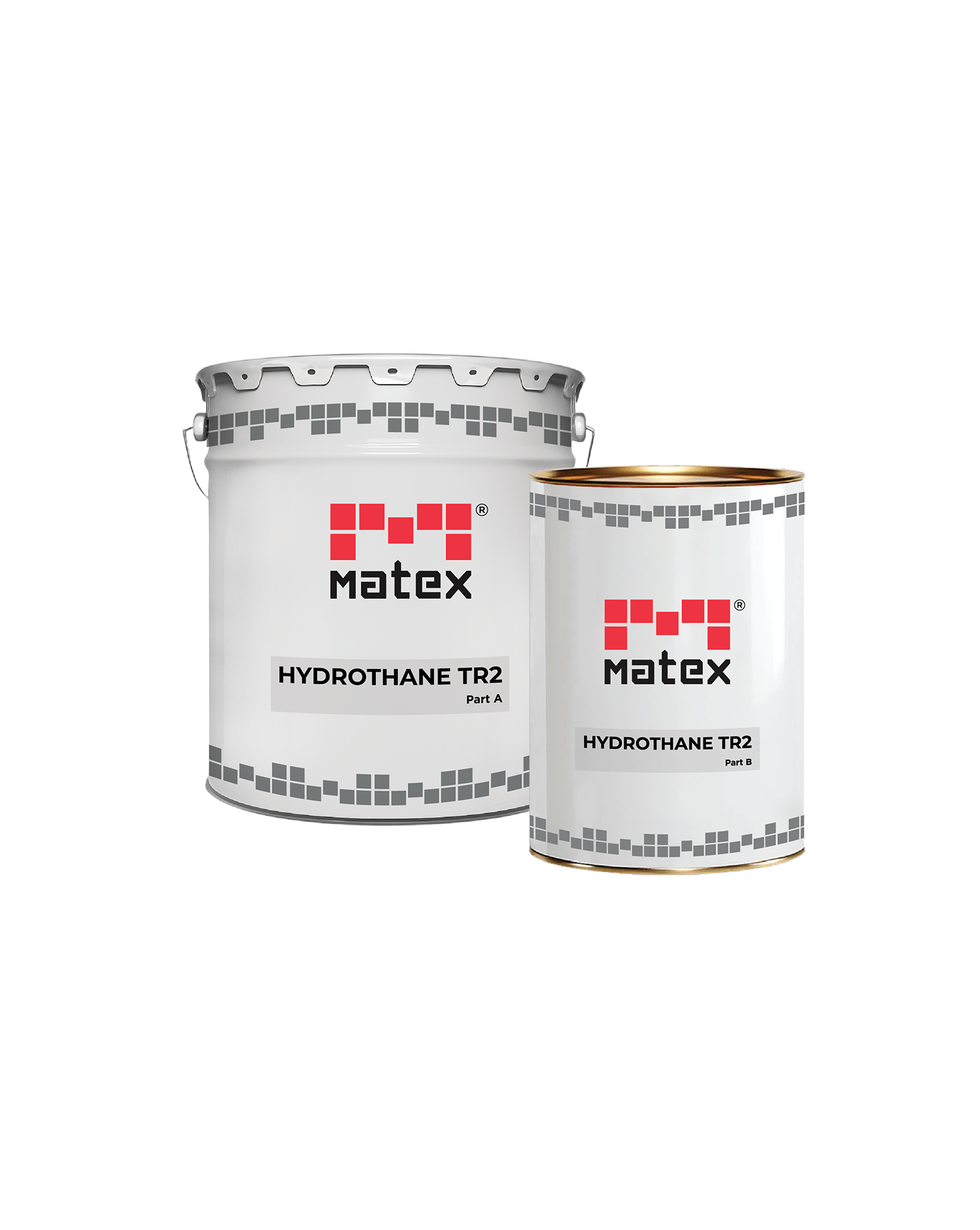
    Hydrothane TR2 two component tar extended polyurethane liquid waterproofing membrane by MATEX

    Hydrothane Tr2

    Two Component Polyurethane Based Tar Extended Liquid Applied Waterproofing Membrane

    HYDROTHANE TR2 is a two-component, chemically cured, high-build liquid waterproofing membrane formulated from polyurethane resins extended with tar for enhanced elasticity and chemical resistance in demanding environments. Upon curing, HYDROTHANE TR2 forms a dense, seamless, monolithic membrane with superior adhesion to concrete, plaster, masonry, cement render, and fiber-reinforced substrates. The membrane is self-priming, vapor permeable to facilitate substrate breathing, and highly resistant to detergents, cleaning agents, brackish water, and saltwater. Its flexibility accommodates structural movements without risk of cracking, while offering high thermal stability suitable for Middle Eastern climates. Easy manual application and straightforward repairability ensure long-term, reliable waterproofing performance.


    Technical data:
    • Color : black liquid coating
    • Application Temperature : 5°C to 40°C
    • Touch dry : 10 hours
    • Full dry : 7 days
    • Service Temperature : -5°C to 80°C
    • Coverage : 1.0 liter per 1m² @ 1mm thickness
    • Packaging : 4 & 15 lit kit

    How to Apply Hydrothane Tr2

    Hydrothane TR2 is mixed on site and applied in two coats to a minimum 1.0 mm dry film thickness.

    1. Prepare the surface. All surfaces should be sound, clean, dry and free from loose material, efflorescence, laitance, curing compounds, dirt, oil and grease, and concrete must be fully cured. Clean metal of rust, oil, paint and contaminants, using mechanical methods or sandblasting on rusted surfaces.
    2. Pretreat cracks and corners. Fill non-moving cracks under 1.0 mm with a 1.0 mm strip of Hydrothane TR2 extending 50 mm each side. Form 45° coving fillets at parapets and columns with Lavarep F40 and apply a 1.0 mm reinforcing strip extending 100 mm each side; patch voids and honeycombs and let them cure.
    3. Seal movement joints. Do not coat expansion and movement joints with Hydrothane TR2. Seal them with Megaseal PU polyurethane sealant.
    4. Prime porous surfaces. Priming is normally not needed. On porous surfaces, or when recoating old coats, dilute Hydrothane TR2 with 10% Armosolvent and use as a primer to reduce blistering.
    5. Mix. Mix component A (base) with a low speed mixer for one minute, slowly add the entire part B (hardener) and mix at 200–300 rpm with a suitable paddle for 3–4 minutes. Do not mix more than can be used within the 30 minute pot life.
    6. Apply two coats. Apply by brush, roller, trowel or airless spray in two coats at approx. 0.65 kg/m² per coat to a minimum 1.0 mm dry film thickness, the second at right angles once the first is completely dry. Apply during falling temperature and check thickness with a gauge.
    7. Protect and finish. Cover the membrane once completely cured with mortar, tiles or the specified finish; it is not designed to be left exposed externally. For tiling, spread silica sand into the final wet coat. Water test only after full cure (minimum 7 days).
    8. Clean tools. Clean all tools with Armosolvent before the product hardens. Hardened material can only be removed mechanically.

    Summary of the method in the Hydrothane Tr2 Technical Data Sheet. Always follow the full TDS on site.

    Standards & Test Methods

    StandardTitleReferenced for
    ASTM D412Standard Test Methods for Vulcanized Rubber and Thermoplastic Elastomers—TensionTensile strength (2.5 N/mm²), elongation (500%), modulus (0.64 N/mm²), recovery from 100% extension (97%)
    ASTM D624Standard Test Method for Tear Strength of Conventional Vulcanized Rubber and Thermoplastic ElastomersTear resistance (9.1 N/mm)
    ASTM D2240Standard Test Method for Rubber Property—Durometer HardnessShore A hardness (50)
    ASTM D4541Standard Test Method for Pull-Off Strength of Coatings Using Portable Adhesion TestersAdhesion to concrete (1.5 N/mm²)
    ASTM C1305Standard Test Method for Crack Bridging Ability of Liquid-Applied Waterproofing MembraneCrack bridging (>2 mm)
    ASTM C836Standard Specification for High Solids Content, Cold Liquid-Applied Elastomeric Waterproofing Membrane for Use with Separate Wearing CourseListed in the TDS

    Standards and test methods as referenced in the Hydrothane Tr2 Technical Data Sheet. Values in the TDS are typical laboratory results under standard conditions.

    Frequently Asked Questions

    What is the coverage of Hydrothane TR2?

    Coverage is 1.0 liter per m² at 1.0 mm dry film thickness. Apply two coats at approx. 0.65 kg/m² per coat to reach a minimum 1.0 mm dry film.

    What is the pot life and drying time of Hydrothane TR2?

    Pot life is 30 minutes at 25°C. Touch dry is 10 hours and full dry is 7 days at 25°C.

    What conditions are needed to apply Hydrothane TR2?

    Application temperature is +5°C to +40°C, relative humidity above 50% and no more than 85%, and substrate temperature at least 3°C above dew point. Service temperature is -5°C to 80°C.

    Can Hydrothane TR2 be left exposed?

    No. The TDS states it is not designed to be exposed in external applications and should be covered with mortar, tiles or another specified finish once fully cured.

    What packaging does Hydrothane TR2 come in?

    It is available in 4 liter and 15 liter sets of two-part metal containers. Shelf life is 12 months in unopened original packing stored at +15°C to 25°C.

    Quick Contact