
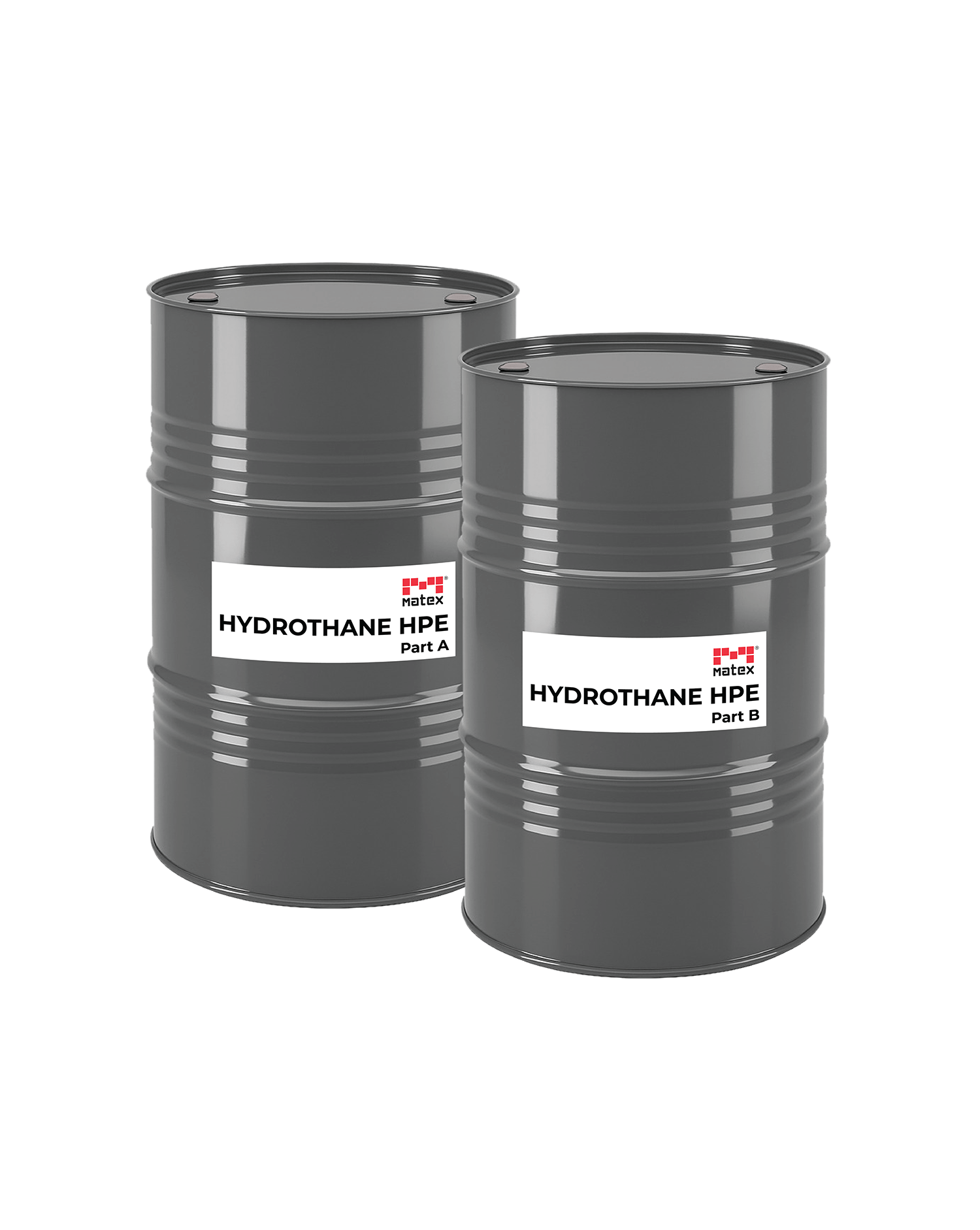
HYDROTHANE HPE is a two-component, solvent-free, spray-applied hybrid polyurea waterproofing membrane engineered for fast, seamless application on complex structures. Utilizing hybrid polyurea technology, HYDROTHANE HPE creates a monolithic, flexible, and highly durable membrane with strong adhesion to concrete, steel, aluminum, wood, and foam. Offering excellent abrasion, impact, and chemical resistance, it ensures long-term performance even under extreme conditions. Its high elongation and thermal stability make it suitable for high-movement structures, while its rapid curing reduces project turnaround times. Environmentally friendly and VOC-free, the membrane adapts to intricate substrate shapes, eliminating stress points and ensuring superior, continuous waterproofing coverage.
Hydrothane HPE is spray applied only, by trained and approved applicators using high pressure heated multi-component equipment; the detailed procedure is in the MATEX method statement.
Summary of the method in the Hydrothane Hpe Technical Data Sheet. Always follow the full TDS on site.
| Standard | Title | Referenced for |
|---|---|---|
| ASTM D638 | Standard Test Method for Tensile Properties of Plastics | Tensile properties (tensile strength ≥ 14–16 MPa) |
| ASTM D2240 | Standard Test Method for Rubber Property—Durometer Hardness | Shore D hardness (40 ± 5) |
| ISO 868 | Plastics and ebonite — Determination of indentation hardness by means of a durometer (Shore hardness) | Shore D hardness |
| ASTM D4060 | Standard Test Method for Abrasion Resistance of Organic Coatings by the Taber Abraser | Taber abrasion (<10 mg CS17, <110 mg H18, 1000 cycles) |
| ASTM D4541 | Standard Test Method for Pull-Off Strength of Coatings Using Portable Adhesion Testers | Pull-off strength (concrete ≥ 1.5 N/mm², steel ≥ 4 N/mm²) |
| ISO 4662 | Rubber, vulcanized or thermoplastic — Determination of rebound resilience | Rebound resilience – listed in TDS, no value given |
Standards and test methods as referenced in the Hydrothane Hpe Technical Data Sheet. Values in the TDS are typical laboratory results under standard conditions.
Only with high pressure heated multi-component spray equipment feeding an impingement spray gun, and only by trained and approved applicators. The mixing ratio is 1:1 by volume and spraying material temperature is 65°C to 75°C.
Approximately 1 kg per m² at 1 mm thickness, subject to site conditions.
Tack free time is 10–20 seconds at 20°C. It takes foot traffic after 1 hour, mechanical load after 2 hours and chemical load after 12–24 hours.
Application temperature is -10°C to +50°C. Below 15°C ambient, the chemical drums should be pre-heated with band heaters to 30 to 40°C.
Uses in the TDS include plant rooms and trafficable roof decks, large commercial and industrial waterproofing, water features, under-screed waterproofing of podium decks, bridges, streets and tunnels, and anti-root sub-terrain waterproofing.