
MATEX
Quick Contact
X

    Navigation
    Close menu
    Theme Color
    Light Dark

    Epoxy Grout

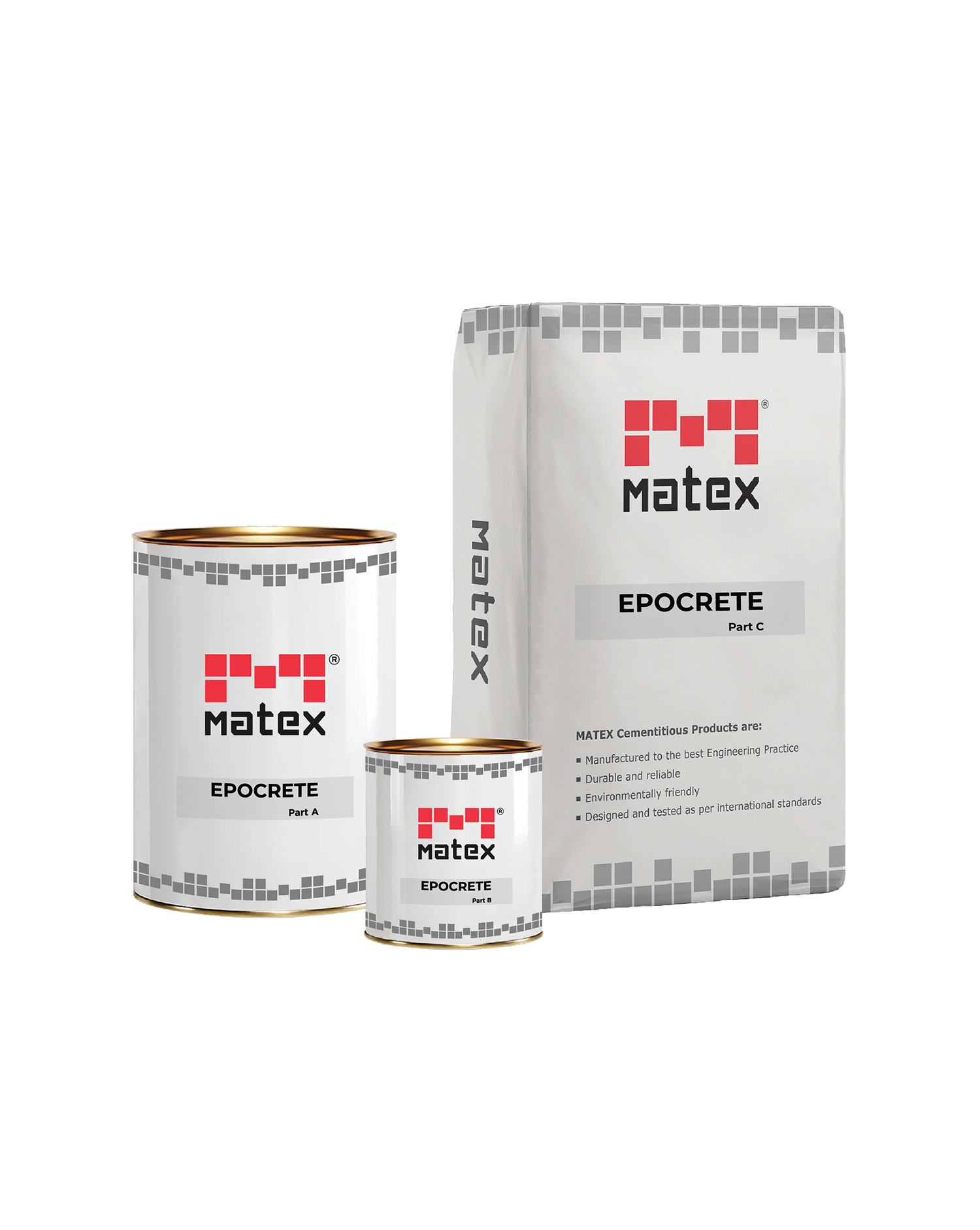
    Epocrete high strength flowable three-component epoxy grout kit by MATEX

    Epocrete

    High Strength Flowable Epoxy Grout

    EPOCRETE is a premium, solvent-free, three-component epoxy grout designed for precision grouting at depths from 10 to 300 mm. Comprising a resin base, hardener, and graded filler, it offers a highly flowable consistency ideal for applications demanding superior mechanical performance. With high compressive, tensile, and flexural strength, it performs exceptionally under static and dynamic loads. The formulation ensures non-shrink, high-adhesion placement, maintaining structural integrity even under thermal stress. Its outstanding chemical resistance and low thermal expansion make it the go-to solution for environments requiring durability and dimensional stability. EPOCRETE delivers lasting performance in critical applications where strength and reliability are essential.


    Technical data:
    • Appearance : grey paste
    • Minimum Grout Depth : 10 mm
    • Maximum Grout Depth : 300 mm
    • Application Temperature : 5°C to 40°C
    • Yield : 14.50 liter of mixed grout per 30 kg kit
    • Packaging : 30 kg kit
    • Shelf life : 12 months

    How to Apply Epocrete

    Epocrete is a three-component, solvent-free epoxy grout poured into sealed formwork under a hydrostatic head.

    1. Prepare the concrete. All surfaces must be dry, clean, and free from oil, grease, water, paints and dust. Remove unsound concrete; the concrete should be sufficiently cured. The concrete must be totally dry when the grout is poured, as a wet surface might cause de-bonding.
    2. Prepare steel surfaces. Steel surfaces should be free of rust or contamination. Sand blast or grind the steel and protect it with Armoprime EP70 solvent-based epoxy primer to prevent rusting from starting again.
    3. Build leak-proof formwork. Construct leak-proof formwork, using foam rubber strip or mastic sealant beneath the formwork and between joints if needed. Use a feeding hopper to provide a hydrostatic head of grout.
    4. Mix the full kit. Stir the base resin and hardener separately for two minutes. Pour all of the hardener (Part B) into the base (Part A) and mix for 2–3 minutes, then slowly add the filler (Part C) and mix for a further 2–3 minutes to a uniform color. Use a slow-speed drill with a suitable paddle; never mix partial quantities or mix by hand.
    5. Pour from one side. Pour the grout from one side of the formwork only, across the shortest distance, to avoid trapping air. Maintain a constant head of preferably at least 15 cm on the pouring side and allow 10 cm clearance between the form and the base plate.
    6. Work within pot life. Use the mixed material within its pot life (30 minutes at 25°C); after this it starts to stiffen and must be discarded. Do not apply below 5°C ambient, and shade the work area and tools in hot conditions as pot life shortens dramatically.
    7. Clean tools. Clean all tools and equipment immediately after use with Armosolvent. Hardened material can only be removed mechanically.

    Summary of the method in the Epocrete Technical Data Sheet. Always follow the full TDS on site.

    Standards & Test Methods

    StandardTitleReferenced for
    EN 1504-6Products and systems for the protection and repair of concrete structures — Anchoring of reinforcing steel barListed in the TDS
    ASTM C579Standard Test Methods for Compressive Strength of Chemical-Resistant Mortars, Grouts, Monolithic Surfacings, and Polymer ConcretesCompressive strength at 7 days: 110 N/mm2
    ASTM C580Standard Test Method for Flexural Strength and Modulus of Elasticity of Chemical-Resistant Mortars, Grouts, Monolithic Surfacings, and Polymer ConcretesFlexural strength at 7 days: 35 N/mm2
    ASTM C307Standard Test Method for Tensile Strength of Chemical-Resistant Mortar, Grouts, and Monolithic SurfacingsTensile strength: 25 N/mm2 at 7 days
    ASTM C882Standard Test Method for Bond Strength of Epoxy-Resin Systems Used With Concrete By Slant ShearBond strength: >3.0 N/mm2
    ASTM D695Standard Test Method for Compressive Properties of Rigid PlasticsCompressive modulus: 15 GPa
    ASTM C531Standard Test Method for Linear Shrinkage and Coefficient of Thermal Expansion of Chemical-Resistant Mortars, Grouts, Monolithic Surfacings, and Polymer ConcretesThermal expansion coefficient: 2.6 x 10⁻⁵ mm/mm/°C
    ASTM C1181Standard Test Methods for Compressive Creep of Chemical-Resistant Polymer Machinery GroutsCreep resistance at 400 psi, 60°C: 2.76 mm/mm

    Standards and test methods as referenced in the Epocrete Technical Data Sheet. Values in the TDS are typical laboratory results under standard conditions.

    Frequently Asked Questions

    What grout depth can Epocrete be poured at?

    The TDS gives a minimum grout depth of 10 mm and a maximum grout depth of 300 mm. Epocrete can be used for thick section applications.

    What is the pot life of Epocrete epoxy grout?

    Pot life is 30 minutes at 25°C. Pot life shortens dramatically at high temperature, so shade the work area and keep tools in shade before use.

    How much grout does a 30 kg kit of Epocrete yield?

    Epocrete yields 14.50 liters of wet mixed grout per 30 kg kit, supplied as base, hardener and filler.

    What is the compressive strength of Epocrete?

    Compressive strength is 110 N/mm2 at 7 days (ASTM C579), with flexural strength of 35 N/mm2 (ASTM C580) and tensile strength of 25 N/mm2 at 7 days (ASTM C307).

    What is the shelf life and storage of Epocrete?

    Epocrete can be used within 12 months from the date of manufacture if stored unopened as recommended. Keep it in dry, covered conditions at 25°C.

    Quick Contact