
MATEX
Quick Contact
X

    Navigation
    Close menu
    Theme Color
    Light Dark

    Epoxy Grout

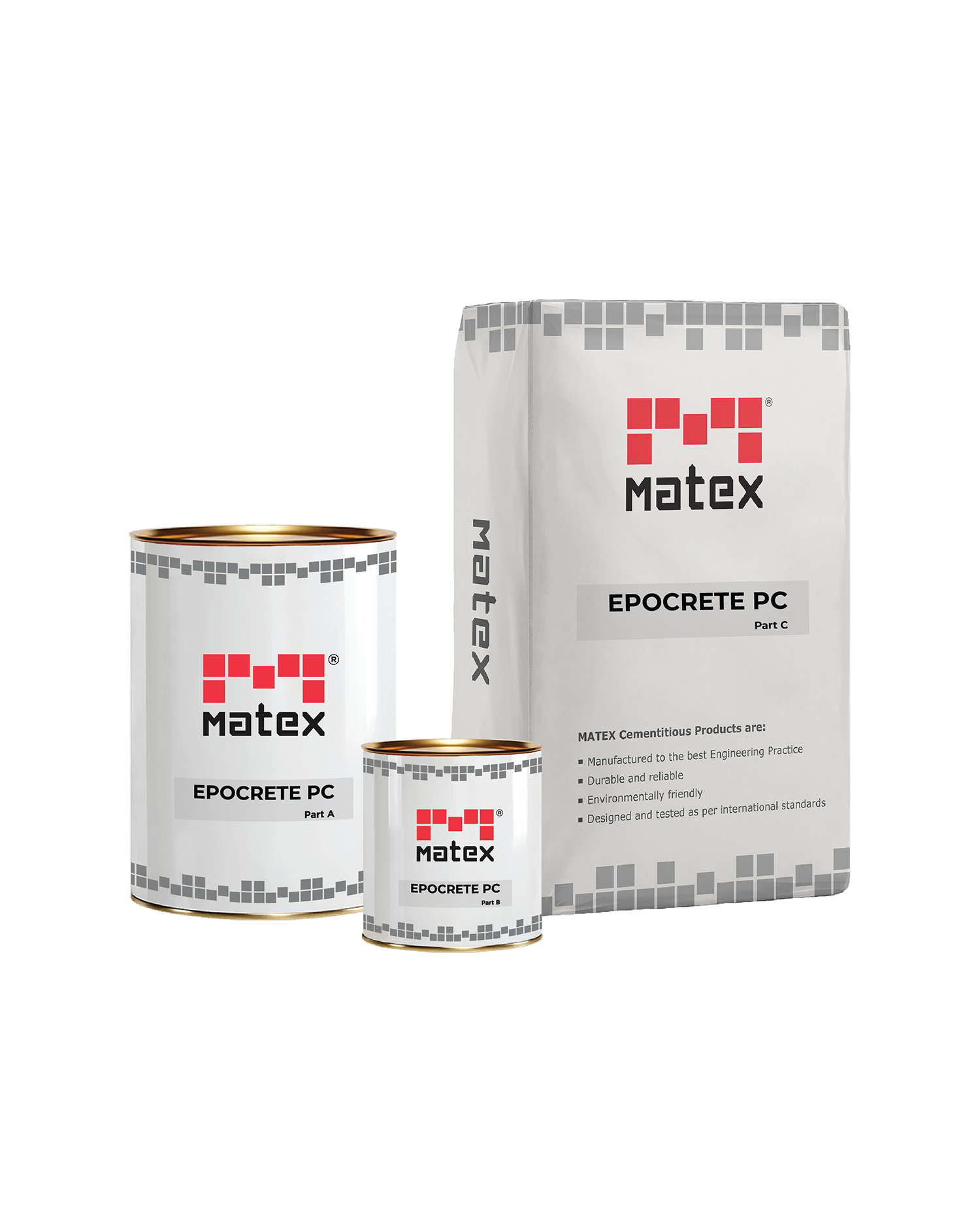
    Epocrete PC flowable pile head re-profiling epoxy grout by MATEX

    Epocrete Pc

    Flowable Pile Head Re-profiling Epoxy Grout

    EPOCRETE PC is a high-performance, three-component epoxy grout designed specifically for pile head re-profiling and waterproofing applications. This self-compacting, free-flowing system forms a dense, impermeable barrier that prevents groundwater ingress through the pile head, ensuring long-term structural protection. With excellent bond strength to concrete, it delivers high compressive strength and superior durability under dynamic loads. It offers exceptional resistance to soil-borne chemicals and is compatible with a wide range of waterproofing systems. EPOCRETE PC provides both mechanical performance and watertight integrity, making it ideal for critical below-ground infrastructure.


    Technical data:
    • Appearance : grey paste
    • Minimum Grout Depth : 10 mm
    • Maximum Grout Depth : 100 mm
    • Application Temperature : 5°C to 40°C
    • Yield : 15.0 liter of mixed grout per 30 kg kit
    • Packaging : 30 kg kit
    • Shelf life : 12 months

    How to Apply Epocrete Pc

    Epocrete PC is poured directly onto the prepared pile head inside leak-proof formwork to re-profile and encapsulate it.

    1. Cut and break out the pile head. Cut the pile boundary at the required level with a concrete saw to give a neat cut with no feather edging, then break out the area to the prepared level.
    2. Clean and protect the rebar. Straighten the reinforcement bars and clean them of rust; grit blast corroded bars to bright metal. Immediately coat the bars with Lavafer or Lavazinc EP to prevent further corrosion, then clean the substrate of dust, loose parts, stripping-oil traces, efflorescence and rust.
    3. Fix the formwork. Construct leak-proof formwork around the pile and coat its inside with release agent, taking care not to coat the top of the pile head.
    4. Mix the three components. Stir base and hardener separately for two minutes, add Part B to Part A and mix with a low-speed drill and paddle for 3 minutes. Add Part C (filler) while mixing for 3–5 minutes more until lump-free, then let the mix rest a few minutes to release entrapped air. Never mix partial quantities.
    5. Place and level. Place the grout directly onto the pile head and let it self-level while watching the formwork for leaks. Level it with a steel trowel to the upper edge of the formwork. Mix enough to grout a full pile head, or equal multiples.
    6. Strip and touch up. After the grout cures, remove the formwork and check the perimeter for defects. Touch up with Lavapoxy Finish to give a smooth, integrated, tight epoxy layer.
    7. Clean tools. Clean tools with Armosolvent before the material hardens; hardened material can only be removed mechanically.

    Summary of the method in the Epocrete Pc Technical Data Sheet. Always follow the full TDS on site.

    Standards & Test Methods

    StandardTitleReferenced for
    EN 1504-6Products and systems for the protection and repair of concrete structures — Anchoring of reinforcing steel barListed in the TDS
    ASTM C579Standard Test Methods for Compressive Strength of Chemical-Resistant Mortars, Grouts, Monolithic Surfacings, and Polymer ConcretesCompressive strength at 7 days: >80.0 N/mm2
    ASTM C580Standard Test Method for Flexural Strength and Modulus of Elasticity of Chemical-Resistant Mortars, Grouts, Monolithic Surfacings, and Polymer ConcretesFlexural strength at 7 days: >21.0 N/mm2
    ASTM C307Standard Test Method for Tensile Strength of Chemical-Resistant Mortar, Grouts, and Monolithic SurfacingsTensile strength at 7 days: 18.0 N/mm2
    BSEN 12390Testing hardened concreteWater permeability: NIL
    ASTM C882Standard Test Method for Bond Strength of Epoxy-Resin Systems Used With Concrete By Slant ShearBond strength: higher than the cohesive strength of concrete
    ASTM C1181Standard Test Methods for Compressive Creep of Chemical-Resistant Polymer Machinery GroutsListed in the TDS
    ASTM C531Standard Test Method for Linear Shrinkage and Coefficient of Thermal Expansion of Chemical-Resistant Mortars, Grouts, Monolithic Surfacings, and Polymer ConcretesListed in the TDS
    ASTM D695Standard Test Method for Compressive Properties of Rigid PlasticsListed in the TDS

    Standards and test methods as referenced in the Epocrete Pc Technical Data Sheet. Values in the TDS are typical laboratory results under standard conditions.

    Frequently Asked Questions

    How is Epocrete PC used for pile head waterproofing?

    Epocrete PC is poured onto the cut pile head inside formwork, where it forms a bonded waterproof barrier that stops underground water leaking from the ground to the pile cap through the pile head. After stripping, a touch-up with Lavapoxy Finish gives an integrated tight epoxy layer.

    What grout depth does Epocrete PC allow?

    Minimum grout depth is 10 mm and maximum grout depth is 100 mm.

    What is the pot life of Epocrete PC?

    Pot life is 45 minutes at 25°C, and it shortens dramatically at high temperature. Do not apply below 5°C ambient.

    How much does a 30 kg kit of Epocrete PC yield?

    Epocrete PC achieves 15.0 liters of wet mixed grout per 30 kg kit, supplied as two metallic containers and a bag of filler.

    How should Epocrete PC be stored?

    Store in original packing in dry conditions, away from direct sunlight, in a temperature-controlled warehouse at 25°C. Shelf life is 12 months from production in unopened original packing.

    Quick Contact