
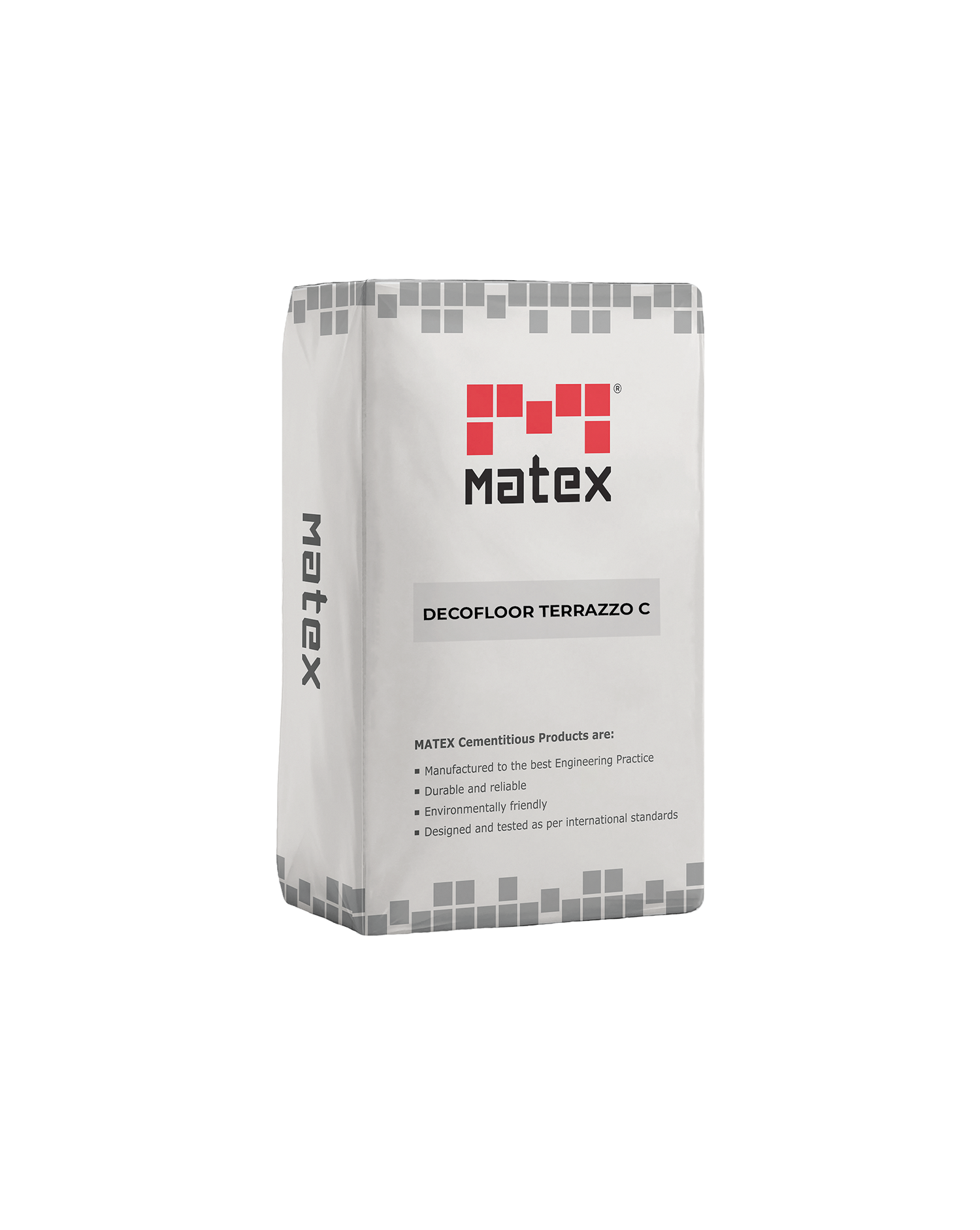
Decofloor terrazzo C
Highly Aesthetic Cementitious Terrazzo Decorative Flooring Compound
DECOFLOOR TERRAZZO C is a dual-component, cementitious terrazzo flooring system composed of crushed marble, glass, and selected natural aggregates. It can be cast as thin as 10 mm, and chemical surface retarders expose aggregate for a rustic or polished finish. Suitable for interior and exterior use, it offers strong adhesion, abrasion resistance, and colorfast durability under UV and harsh conditions. Non-toxic and environmentally friendly, DECOFLOOR TERRAZZO C delivers smooth or textured surfaces in matt or gloss, with seamless and hygienic finishes achievable using divider strips. Ideal for decorative landscaping or flooring.
Technical data:
- Appearance : colored cement
- Application Temperature : 10°C to 40°C
- Thickness : as low as 10 mm
- Curing time : 12-18 hours (air cure), Minimum 3 days (water cure)
- Coverage : 2 bags matrix per 4 square meter for 10 mm thickness blended With 1 bag chips
- Packaging : Decofloor Terrazzo C matrix: 25 kg bag, Decofloor Terrazzo C chips: 25 kg bag
- Packaging : Matrix: 25 kg bag, Chips: 25 kg bag
How to Apply Decofloor terrazzo C
Decofloor Terrazzo C matrix and chips are mixed with water, laid over a tacky primer between divider strips, cured, then ground and polished or retarded for an exposed aggregate finish.
- Prepare the substrate. Surfaces should be sound, clean, dry and free from loose material, efflorescence, laitance, curing compounds, dirt, oil and grease. Shot blast or diamond grind to remove weak material and roughen the surface, repair damage with MATEX concrete repair products, respect existing joints, and allow new concrete to cure at least 28 days with moisture not exceeding 5%.
- Set divider and joint strips. Set aluminum, brass, stainless steel or bronze divider strips in an adhesive bed or with mechanical anchors to the designed layout. Install control joint strips back to back above slab control joints and expansion joints above slab expansion joints; internally, expansion joints should be in bays no larger than 6 m x 6 m, with joints around columns and the perimeter.
- Prime. Prime with Armoprime AC at 4–6 m²/liter, adding a second coat on very porous substrates, and apply the terrazzo while the primer is still tacky. Alternatively, use an Armoprime Grip slurry and lay the mix while it is fresh; in extreme weather, saturate the substrate with water the day before.
- Mix. Pour 9.75–10 liters of clean, cold water into a handheld concrete mixer with a helical blade, add 50 kg (2 bags) of matrix under slow mixing, then 25 kg (1 bag) of chips until lump-free and elastic but not flowing. Let stand 3 minutes, remix, and use within half an hour; keep the mix temperature at or below 28°C.
- Place. Distribute the mix with a trough and gauge rake into each color area, then tamp, trowel and level with a straight edge and steel floats so chips are spread uniformly over the surface; seed extra chips if needed. Avoid excessive early troweling or rolling, and separate castings of different colors by at least a day.
- Cure. Air cure under plastic sheet for 12 to 18 hours, then water cure with permanent water on the surface for a minimum of 3 days, protecting the floor from extreme temperatures.
- Grind and polish, or expose. For a polished finish, let the floor cure 3 to 4 days and dry 3 more, then grind with multi-head machines and metal bond diamonds from 35 or 40 grit, grout pinholes with fine powder sieved from the mix, cure the grout, and polish with resin bond diamonds. For a rustic exposed aggregate finish, apply retarder when the surface sheen diminishes (1–4 hours after casting) and wash progressively with a pressure pump or brush.
- Seal. Clean the surface thoroughly and apply a protective sealer from the MATEX sealer range; for a natural gloss polished to 1,500 or 3,000 grit, use a penetrating sealer. Re-seal periodically against traffic wear.
Summary of the method in the Decofloor terrazzo C Technical Data Sheet. Always follow the full TDS on site.
Standards & Test Methods
| Standard | Title | Referenced for |
| ASTM C531 | Standard Test Method for Linear Shrinkage and Coefficient of Thermal Expansion of Chemical-Resistant Mortars, Grouts, Monolithic Surfacings, and Polymer Concretes | Coefficient of thermal expansion |
Standards and test methods as referenced in the Decofloor terrazzo C Technical Data Sheet. Values in the TDS are typical laboratory results under standard conditions.
Frequently Asked Questions
What is the minimum thickness of Decofloor Terrazzo C?
Decofloor Terrazzo C can be cast as low as 10 mm, depending on aggregate size. Unlike epoxy terrazzo, it can also be applied economically at higher thicknesses for larger aggregates.
What is the coverage of Decofloor Terrazzo C?
Two bags of Decofloor Terrazzo C matrix cover about 4 m² at 10 mm thickness when blended with one bag of Decofloor Terrazzo C chips. Coverage is approximate and subject to site conditions.
Can Decofloor Terrazzo C be used outdoors?
Yes. It is suitable for internal and external application and is resistant to UV rays and harsh weather; an exposed aggregate finish is slip resistant for walkways, plazas, parks and pool decks.
How should Decofloor Terrazzo C be cured?
Air cure under plastic sheet for 12 to 18 hours, then keep permanent water on the surface for a minimum of 3 days. Without curing, the risk of cracking and low strength is greatly increased.
When can Decofloor Terrazzo C be ground and polished?
The floor needs to cure for 3 to 4 days and then dry for 3 more days before grinding, depending on ambient temperature.