
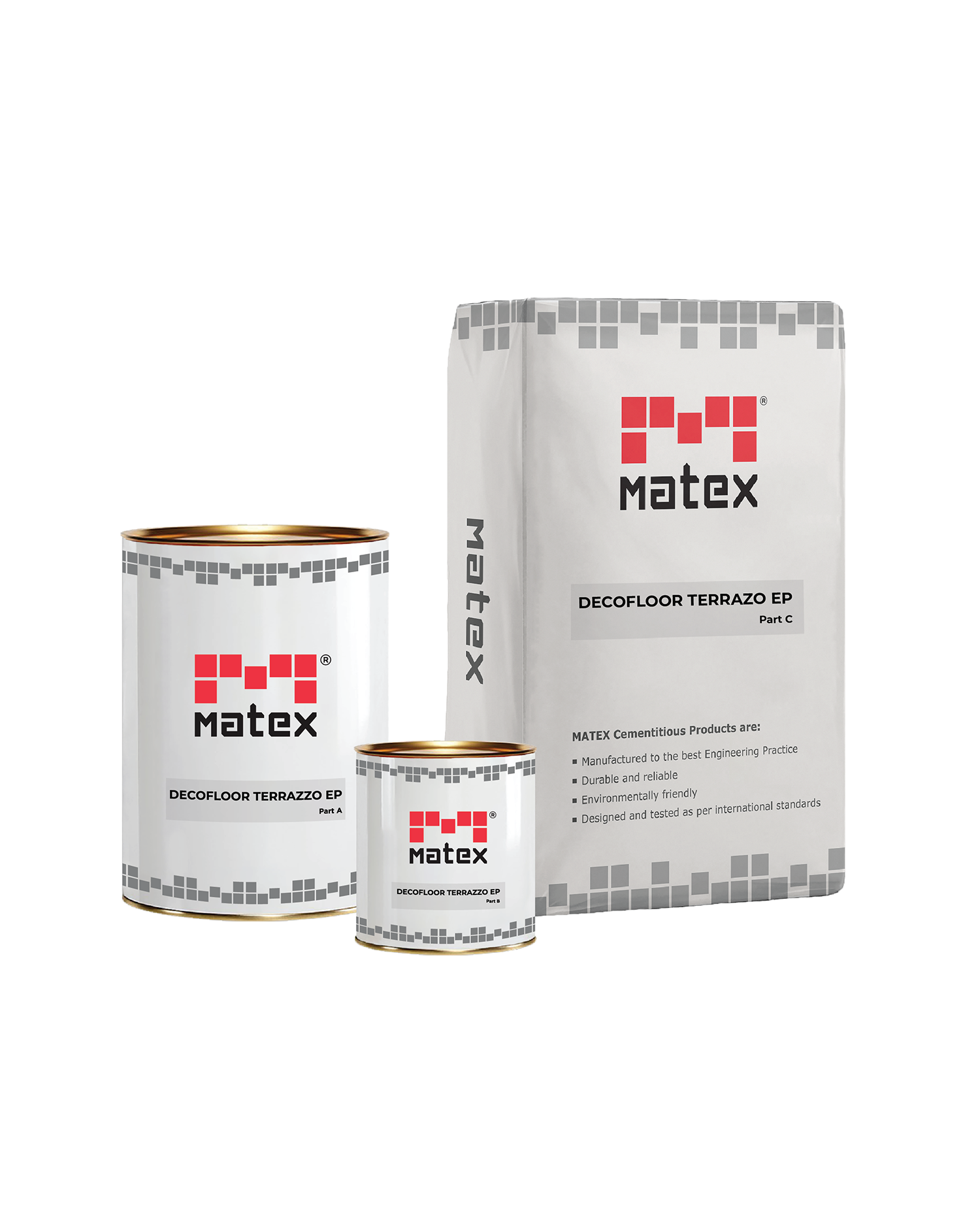
Decofloor terrazo Ep
Highly Aesthetic Decorative Epoxy Terrazzo Flooring
DECOFLOOR TERRAZZO EP is a solvent-free, decorative epoxy terrazzo flooring system combining pigmented epoxy resin with marble, colored glass, granite, or approved aggregates. Installed at 8–12 mm thickness, it delivers a seamless, hygienic surface ideal for high-traffic commercial, industrial, or institutional spaces. It is scratch, stain, chemical, and impact resistant, with no fading or shrinkage. This thin, lightweight topping minimizes structural load while providing exceptional longevity and low lifecycle costs. With extensive color options and low-odor application, DECOFLOOR TERRAZZO EP is a durable and highly aesthetic solution for heavy-duty flooring.
Technical data:
- Appearance : colored paste
- Application Temperature : 10°C to 40°C
- Curing time : minimum 24 hours at 25°C before grinding
- Coverage : 20 kg/m² at 10 mm thickness
- Packaging : Component A: 3.66 kg, Component B: 1.44 kg, Component C: 10.80 kg (fine filler), 14.10 kg (coarse)
How to Apply Decofloor terrazo Ep
Decofloor Terrazzo EP is troweled at 8 to 12 mm between fixed divider strips over a quartz-broadcast epoxy primer, then ground, grouted, polished and sealed.
- Prepare the substrate. Surfaces should be sound, clean, dry and free from loose material, efflorescence, laitance, curing compounds, dirt, oil and grease, and tested for moisture; new concrete should cure at least 28 days with moisture not exceeding 5%. Shot blast or diamond grind to remove weak material and roughen the surface, repair damage with MATEX epoxy repair products, and install a vapor barrier on slabs on grade, as the topping is not breathable.
- Fix divider strips. Fix aluminum, brass, stainless steel or bronze divider strips permanently to the substrate with Epofix T epoxy adhesive, with their top at finished floor level; for design elements, saw cut a groove at least 10 mm deep, clean it with an air gun and set the strip in Epofix T. Install control and expansion joints with two strips back to back directly above slab joints, and leave flexible joints around columns and the perimeter.
- Prime. Apply Armoprime EP epoxy primer to the prepared substrate and, while it is still wet, broadcast Quartz no. 2 or 3 at 1.0 to 2.0 kg per m² for mechanical keying.
- Mix. Premix component A with a slow-speed drill and jiffy blade for one minute, add component B and blend for at least three minutes without entrapping air. Add 1 bag (20 kg) of epoxy filler and 2 bags (40 kg) of approved aggregate and mix 3–4 minutes until all aggregate is wet out; mix no more than can be applied within 30–40 minutes.
- Place and trowel. Place the mix on the primed surface in lines or small areas, at least 2 mm thicker than the final thickness after grinding, using a flat trowel or gauge rake with the largest chip as a thickness guide. Fill all voids and corners; a power trowel is highly recommended for level, compacted results.
- Grind and grout. After a minimum of 24 hours curing at 25°C (longer at lower temperatures), grind with multi-head machines and diamond tools, starting with a 30/40 grit metal bond tool and progressing through every stage, for example 40, 80, 150, 250, 400, 800. Fill pinholes with the separately supplied epoxy-filler grout kit, allow 24 hours, remove excess at the final metal-bond stage, and polish wet with resin-bond tools.
- Seal. Clean the polished surface thoroughly and apply a protective sealer from the MATEX sealer range for resistance to staining by water, chemicals, oil, grease and solvent. Re-seal periodically against traffic wear.
- Clean tools. Clean mixing and application equipment immediately after use with Armosolvent.
Summary of the method in the Decofloor terrazo Ep Technical Data Sheet. Always follow the full TDS on site.
Standards & Test Methods
| Standard | Title | Referenced for |
| ASTM D695 | Standard Test Method for Compressive Properties of Rigid Plastics | Compressive strength |
| ASTM D790 | Standard Test Methods for Flexural Properties of Unreinforced and Reinforced Plastics and Electrical Insulating Materials | Flexural strength |
| ASTM D638 | Standard Test Method for Tensile Properties of Plastics | Tensile strength |
| ASTM D2240 | Standard Test Method for Rubber Property—Durometer Hardness | Shore D hardness |
| ASTM D4060 | Standard Test Method for Abrasion Resistance of Organic Coatings by the Taber Abraser | Abrasion resistance (CS-17) |
| ASTM D570 | Standard Test Method for Water Absorption of Plastics | Water absorption |
| ASTM D696 | Standard Test Method for Coefficient of Linear Thermal Expansion of Plastics Between −30°C and 30°C with a Vitreous Silica Dilatometer | Thermal coefficient of linear expansion |
| DIN 1048 | Testing methods for concrete (Prüfverfahren für Beton) | Water permeability |
Standards and test methods as referenced in the Decofloor terrazo Ep Technical Data Sheet. Values in the TDS are typical laboratory results under standard conditions.
Frequently Asked Questions
What thickness is Decofloor Terrazzo EP installed at?
Decofloor Terrazzo EP is trowel applied at 8 to 12 mm nominal thickness. The minimum recommended thickness is 8 mm before grinding, which drops to 6 mm after grinding and polishing.
What is the coverage of Decofloor Terrazzo EP?
Approximately 20 kg/m² at 10 mm thickness produces an 8.0 mm finish after grinding and polishing.
How long before Decofloor Terrazzo EP can be ground?
The topping must cure for a minimum of 24 hours at 25°C before any grinding or polishing. Lower temperatures require longer curing times.
Can Decofloor Terrazzo EP be used outdoors?
It is not recommended for external applications, as UV radiation may cause color change on certain colors, especially dark ones. It should also not be applied where there is negative hydrostatic pressure.
What is the pot life of Decofloor Terrazzo EP?
Pot life is 1 hour at 25°C and 30 minutes at 35°C. The TDS advises not to mix more material than can be applied within 30–40 minutes.