
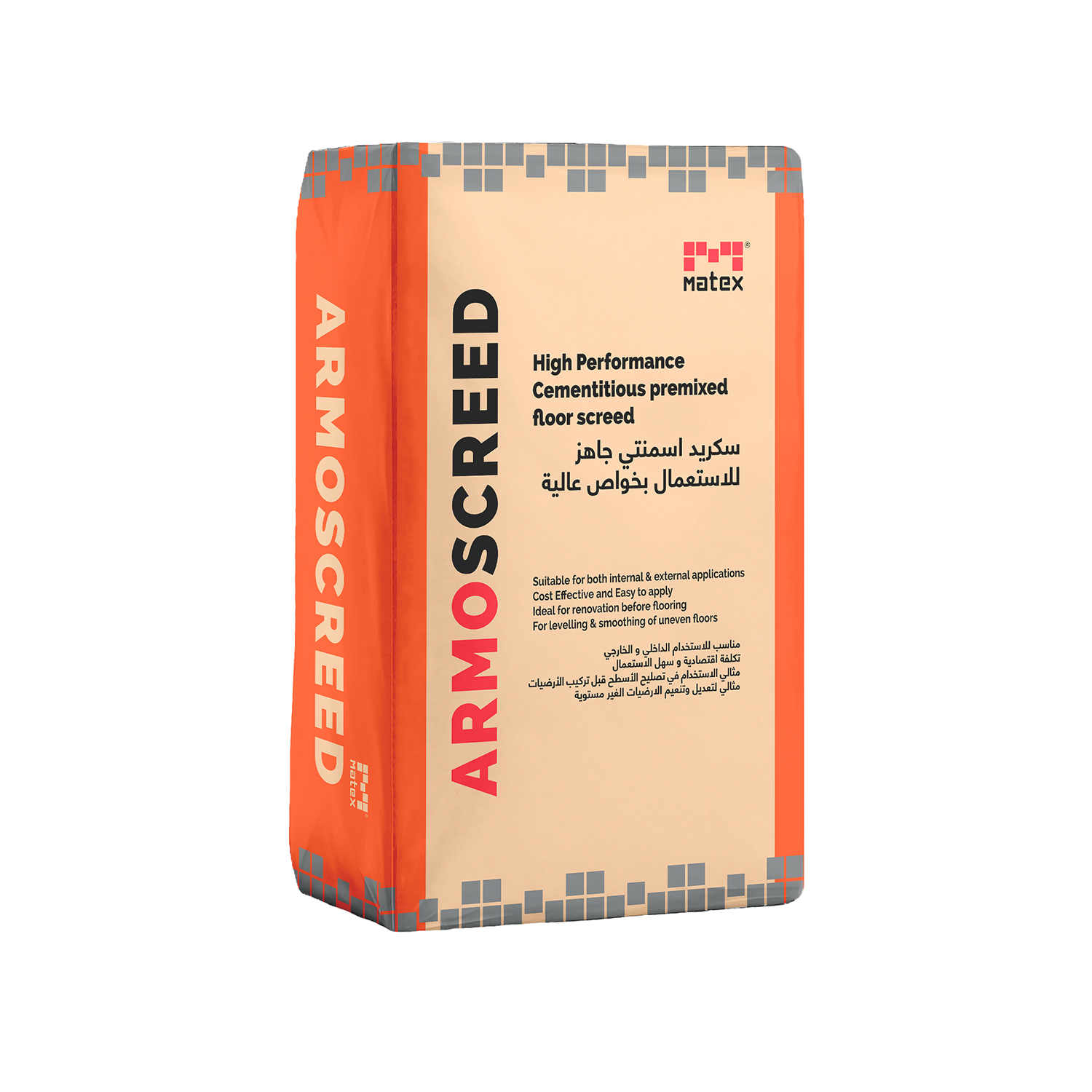
Armoscreed
Cement Based Heavy Duty Floor Screed
ARMOSCREED is a high-performance, cement-based, single-component floor screed designed for heavy-duty leveling applications at thicknesses ranging from 40 to 100 mm. Formulated with hydraulic cement, graded aggregates, silica, fibers, and special chemical additives, it delivers high compressive strength and excellent bonding to cementitious substrates. ARMOSCREED offers easy, trowelable application and reliably accepts a wide range of subsequent finishes, including tiles, PVC sheets, rubber sports flooring, and epoxy coatings. Its durable composition makes it ideal for pedestrian traffic and medium load-bearing areas, providing a stable, compatible base layer for demanding flooring systems.
Technical data:
- Color : cement grey powder
- Application Temperature : 5°C to 35°C
- Service Temperature : -30°C to 90°
- Open to foot traffic : 24 hours
- Coverage : 2.0 kg per square meter per 1mm thickness
- Packaging : 50 kg bag
How to Apply Armoscreed
Armoscreed is laid between guides on a bonded, unbonded or floating substrate, compacted and floated to level, then cured as a normal cementitious material.
- Prepare the substrate. Concrete should have been placed for at least 28 days and be sound, clean, dry and free from loose material, efflorescence, laitance, curing compounds, dirt, oil and grease. Remove contamination or excessive laitance by grinding, captive blasting or sand blasting, and carry out repairs with a MATEX concrete repair product.
- Prime or soak. For a fully bonded screed, apply Armoprime AC at 4 to 6 m²/lt, or an SBR slurry of 1 volume Megabond SBR, 1 volume clean water and 1 volume fresh cement, laying the screed immediately onto the wet slurry. For an unbonded screed no primer is needed; soak the concrete with clean water and let free water disperse. For a floating screed, place a separating or damp-proof membrane over the substrate.
- Mix. Pour 4.5 to 5.0 liters of water into a container and add the 50 kg bag, mixing with a low-speed drill mixer (200–300 rpm) and paddle, or a vessel mixer for large production, for 3 minutes until uniform and lump-free. Do not add further water, and never add water once the mix starts to set.
- Place and compact. Set out the floor with guides and mix enough material for the area to avoid multiple casting times. Spread the mix to the desired thickness, then compact and level it carefully, as Armoscreed is not self-leveling.
- Finish. Allow the material to initially set before final touches with an aluminum float or a helicopter floating machine. Do not wet the top of the screed to smooth it with the trowel.
- Protect and cure. Protect the floor from direct sunlight, high winds or rain, and cure as per normal curing practice for cementitious materials. Apply overlayment once Armoscreed is fully cured.
- Clean tools. Clean tools and equipment with water before the material hardens; hardened material can only be removed mechanically.
Summary of the method in the Armoscreed Technical Data Sheet. Always follow the full TDS on site.
Standards & Test Methods
| Standard | Title | Referenced for |
| BS EN 13813 | Screed material and floor screeds — Screed material — Properties and requirements | Listed in the TDS |
| ASTM C109 | Standard Test Method for Compressive Strength of Hydraulic Cement Mortars (Using 2-in. or [50 mm] Cube Specimens) | Compressive strength |
| ASTM C580 | Standard Test Method for Flexural Strength and Modulus of Elasticity of Chemical-Resistant Mortars, Grouts, Monolithic Surfacings, and Polymer Concretes | Flexural strength |
Standards and test methods as referenced in the Armoscreed Technical Data Sheet. Values in the TDS are typical laboratory results under standard conditions.
Frequently Asked Questions
What thickness can Armoscreed heavy duty floor screed be laid at?
Armoscreed is formulated for an application thickness of 40 mm to 100 mm. It is not self-leveling and must be compacted and leveled by hand or machine float.
What is the coverage of Armoscreed?
Armoscreed covers approximately 2.00 kg per square meter per 1 mm thickness. Coverage is approximate and subject to site conditions.
What strength does Armoscreed achieve?
Armoscreed achieves a compressive strength of >35 N/mm² (ASTM C109) and a flexural strength of >9 N/mm² (ASTM C580). It is designed for pedestrian traffic and medium loads.
When can Armoscreed be walked on?
Armoscreed is open to foot traffic after 24 hours. The time before laying floor finishes varies with thickness, humidity and weather, so consult MATEX Technical Department for specific guidance.
Can pipes or conduits be laid inside Armoscreed?
Yes. The mortar above the conduit or pipe should be at least 25 mm thick and reinforced with galvanized steel mesh.